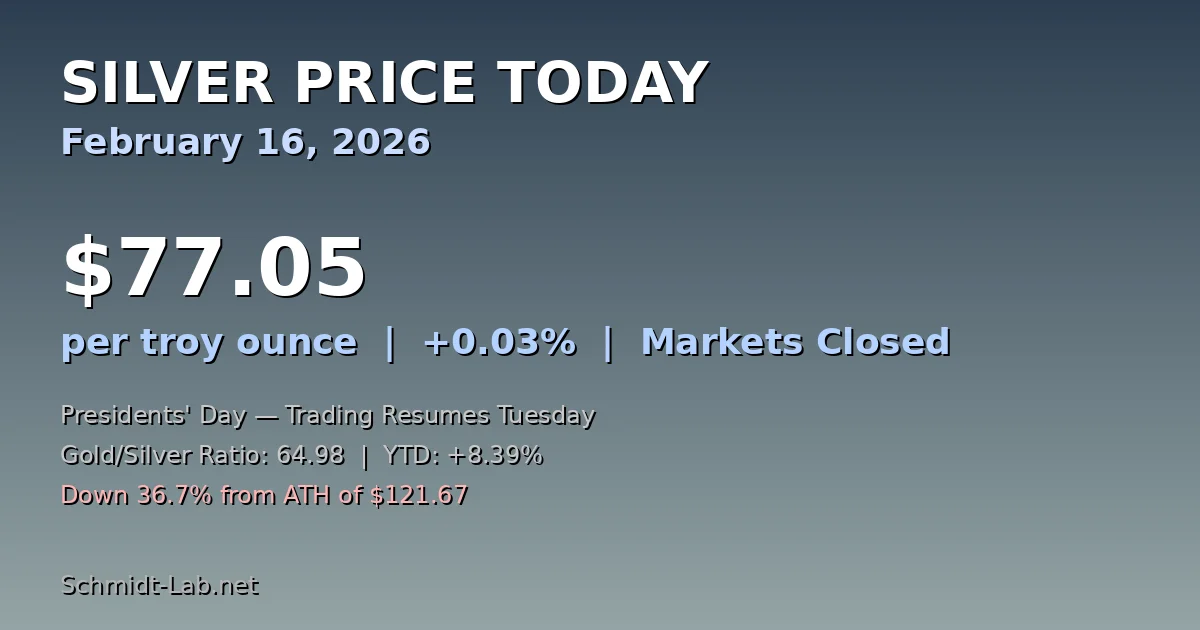
Silver just posted its best January in decades, hitting an all-time high of $121.67 on January 29, 2026. The question burning through bullion markets isn't "will silver go higher," but rather how much higher and what prevents the climb from accelerating further. Bank forecasts diverge sharply—from capitulation scenarios under $60 to explosive bull cases above $150—reflecting fundamental uncertainty about industrial demand, monetary policy, and supply constraints.
Understanding these competing narratives helps you distinguish between realistic price targets and hype-driven speculation.
Bank Forecasts for Silver in 2026
Major financial institutions have published 2026 outlook documents. Here's what the consensus looks like:
| Institution | Average 2026 Forecast | Range | Primary Thesis |
|---|---|---|---|
| JPMorgan | $81 | $75-$85 | Stable with modest industrial demand growth; inflation recedes |
| Goldman Sachs | $92.50 | $85-$100 | Supply deficit persists; industrial demand resilient |
| Bank of America | $60 | $55-$65 | Bearish on macro; demand destruction likely; dollar strength |
| Citigroup | $150 | Bull Case Only | Supply deficit + industrial demand + Fed accommodation = squeeze |
| UBS | $90 | $85-$95 | Balanced view; supply constraints support floor |
| Average (Ex-Outliers) | $81-$92 | N/A | Consensus cluster around low-mid $80s to low-mid $90s |
Key Takeaway: The consensus clusters between $75-$100, with outliers suggesting either capitulation to $55 (BofA) or a squeeze to $150 (Citi). The wide dispersion reflects genuine uncertainty, not disagreement about facts.
Technical Analysis: Support and Resistance Levels
Technical traders identify levels where price momentum historically reverses. For silver in 2026, these are critical:
- Resistance Levels (Selling Pressure):
- $121.67 – All-Time High (January 29, 2026). Breaking above triggers breakout trades.
- $110-$115 – Psychological zone. Previous rallies stalled here in 2011 (adjusted for recent gains).
- $100-$105 – Major technical resistance. Represents a psychological barrier and previous intermediate peak.
- $90 – Consensus average forecast acts as soft resistance from profit-taking.
- Support Levels (Buying Interest):
- $70-$75 – Recent consolidation range (February 2026). Strong institutional support observed here.
- $65-$70 – Secondary support. Loss of this level triggers larger sell orders.
- $60 – Psychological floor. Below this, the narrative shifts from "correction" to "trend reversal."
- $50 – Capitulation level. Only breaks on recession or supply glut.
Technical Interpretation: Silver is currently in consolidation above the $70 support. A close above $110 would suggest momentum toward $121+ and potential test of $130-$150. A break below $70 would signal weakness and potential retest of $50-$60.
Volume analysis matters: If prices rise on light volume, that's less bullish than rises on heavy volume. Watch CME Commitment of Traders reports to gauge commercial (bullish) vs. speculative (often unsustainable) positioning.
The Bull Case: Why Silver Could Exceed $120
Several scenarios support higher prices:
- Supply Deficit Continues Widening
- Silver has recorded 6 consecutive years of global supply deficits
- Cumulative shortfall: ~820 million ounces (largest in 70 years)
- Above-ground stockpiles declining steadily
- Mining production cannot accelerate quickly (71% is byproduct; can't increase output independently)
If the deficit persists through 2026, the market faces a genuine shortage. Prices must rise to ration demand or incentivize scrap recycling and above-ground inventory liquidation. Historical precedent: 2010-2011 when silver rose from $13 to $48 over two years partly due to supply tightness.
- Industrial Demand Accelerates
- Solar energy: 185-240 million ounces annually and growing 15-20% per year
- Electric vehicles: 90+ million ounces annually, production ramping exponentially
- AI/data centers: Emerging demand for silver in thermal management and conductive coatings
- 5G infrastructure: Continued build-out requires substantial silver
If even one of these demand streams surprises to the upside (solar exceeds forecasts, EV adoption accelerates), supply deficit deepens and prices rise faster.
- Central Bank Buying
- China, Russia, and India accumulating silver reserves
- No formal coordination, but momentum evident in purchasing data
- Central banks buying precious metals as alternative reserves to USD assets
- If buying accelerates, spot prices must rise to equilibrate supply/demand
- Fed Accommodation Returns
- If the Federal Reserve pauses or reverses rate hikes due to economic weakness
- Low or negative real interest rates make precious metals more attractive
- Investors flee financial assets into tangible hedges
- Inflation resurgence would support both gold and silver
Citi's $150 Thesis Explained: Citigroup models a scenario where all these factors converge. Sustained supply deficit + industrial demand growth + Fed cuts + central bank buying + retail inflows = insufficient supply at current prices. Prices must spike to $150+ to clear markets. This is plausible but requires several dominoes falling correctly.
The Bear Case: Why Silver Could Drop to $50
Equally credible downside scenarios exist:
- Recession Crushes Industrial Demand
- If global GDP growth turns negative, manufacturers defer projects
- Solar and EV deployment slow due to financing constraints and reduced consumer demand
- Industrial demand for silver could fall 20-30% in a severe recession
- Supply deficit becomes supply surplus if demand collapses
Historical precedent: 2008-2009 saw silver fall from $21 to $8 within months when demand evaporated.
- Dollar Strength Emerges
- Inverse relationship between USD index and silver prices
- Strong dollar makes silver expensive for non-USD buyers
- If Fed maintains rates at elevated levels, capital flows into dollars
- Precious metals underperform against strengthening currency
- Above-Ground Stockpile Release
- Central banks or large institutions holding silver for decades could liquidate
- A single large sale could saturate markets
- If recent ETF inflows reverse dramatically, massive selling pressure emerges
- Supply deficit narrative breaks if above-ground inventory floods markets
- Speculative Bubble Bursts
- January 2026 rally lifted prices 180% in 12 months
- Unusual moves attract retail speculation and leverage
- Margin calls and forced liquidations create waterfall declines
- Leverage embedded in futures positioning could amplify downward moves
- Fed Tightens Instead of Cuts
- Contrary to current expectations, if inflation remains sticky
- Higher real interest rates make non-yielding precious metals less attractive
- Capital flows back into bonds, stocks, and high-yield savings
- Speculative positions unwind into lower prices
BofA's $55 Thesis Explained: Bank of America models a U.S. recession + Fed tightening cycle + strong dollar environment. Industrial demand drops 25%, central banks pause purchases, and speculators exit. Prices retrace to $55-60 as the market reprices assuming the supply deficit was transient rather than structural.
Bull vs. Bear Scenario Comparison
Here's how the two cases stack against each other:
| Factor | Bull Case ($120+) | Bear Case ($50) | Probability (Current) |
|---|---|---|---|
| Supply Deficit | Persists and widens | Reverses or stabilizes | Favor Bull (65%) |
| Industrial Demand | Accelerates with renewables/EVs | Collapses in recession | Neutral (50%) |
| Fed Policy | Cuts rates; loose monetary | Raises rates; tight monetary | Favor Bull (60%) |
| Inflation | Resurges; real rates negative | Controlled; real rates positive | Neutral (50%) |
| Dollar Strength | Weakens | Strengthens sharply | Favor Bull (55%) |
| Central Bank Demand | Continues accumulating | Pauses; potential selling | Favor Bull (60%) |
The bull case has more tailwinds currently, but the bear case isn't speculative—it's based on reasonable assumptions about cyclical mean reversion.
Historical Rallies and Comparisons
Context helps calibrate expectations. Here's how current and past silver rallies compare:
- 1980 Hunt Brothers Squeeze
- Rally: $8 → $49.45 (518% gain)
- Duration: 12 months
- Cause: Attempted cornering; speculation
- Ending: Margin call cascade; prices fell to $10 within two years
- Lesson: Speculative bubbles don't last; supply eventually emerges
- 2010-2011 Post-QE Rally
- Rally: $13 → $48.75 (275% gain)
- Duration: 2 years
- Cause: Fed QE, inflation expectations, industrial demand growth
- Ending: Inflation didn't materialize; Fed tightened; fell to $26
- Lesson: False narratives unwind; supply/demand must support prices
- 2024-2026 Supply Deficit Rally
- Rally: $30 → $121.67 (305% gain)
- Duration: 13 months (ongoing)
- Cause: Documented supply deficit, industrial demand surge, central bank buying
- Ending: TBD
- Key Difference: Built on documented supply constraints (unlike 1980 or 2011)
The current rally resembles 2010-2011 in magnitude but differs in fundamentals. The supply deficit is real and measurable, not a narrative about "expected" inflation. This distinction matters for sustainability.
What Could Trigger Further Upside
Key catalysts to watch:
- Unexpected mine disruption (geopolitical event, accident) reducing supply
- Solar deployment beat (Germany, India, or China exceeding projections)
- Fed capitulation (three consecutive rate cuts triggering risk-on)
- China stimulus (fiscal spending supporting commodities demand)
- ETF inflows acceleration (retail discovering supply deficit narrative)
- Supply deficit widening (new data showing 2025 shortfall larger than forecast)
Risk Factors Limiting Upside
Realistic headwinds include:
- Recession probability (inverted yield curve signals risk)
- Margin calls (if leverage unwinds on consolidation, cascading selling)
- Above-ground inventory surprise (major holders liquidating)
- Technology substitution (less silver needed per solar panel due to efficiency gains)
- Dollar strength (stronger dollar makes commodities less attractive)
Realistic Price Targets for 2026
Synthesizing bank forecasts, technical analysis, and fundamental factors:
- Base Case (60% probability): $75-$95
- Supply deficit persists but doesn't widen dramatically
- Industrial demand stays resilient but not exceptional
- Fed cuts rates modestly; inflation moderates
- Technical support at $70 holds; resistance at $105-110 constrains rallies
- Bull Case (25% probability): $100-$150
- Supply deficit widens beyond forecasts
- EV/solar deployment exceeds expectations
- Fed forced to cut rates aggressively
- Breakout above $115 triggers momentum buying toward $130-150
- Bear Case (15% probability): $50-$70
- Recession triggers demand destruction
- Fed maintains tighter stance longer than expected
- Central banks pause purchases
- Break below $70 support signals retest of $50-60
The consensus doesn't predict a new ATH in 2026, but rather consolidation with upside bias. Most institutions expect silver to range between $75-$100, with a tail-risk move to $150 if everything aligns for bulls, and an equally improbable drop to $50 if all bear factors materialize simultaneously.
For deeper context on what's driving these forecasts, see our complete silver price and value guide and where silver is headed in 2026.
The higher silver goes, the more compelling the bear case becomes. At $121.67, valuations are elevated relative to historical norms. But at $50, the bull case becomes overwhelming. The market will find an equilibrium price in 2026, and your edge comes from understanding which scenarios have the highest probability.You May Also Like
Sources
Written by
Sarah Kim
Collectibles market analyst covering precious metals, coins, and alternative investments.